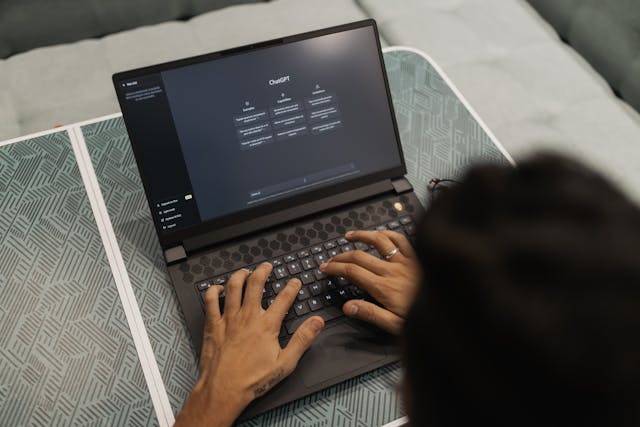
AI – Either Bright and Dark, Depends on Your Preparation
Before we talk about AI’s impact, ask yourself: Are you at the beginning or the end of your career? Are your skills average or above the crowd? Do you work hard to improve yourself or do you coast? Does your job really require soft, human skills? Are you vulnerable?
If you haven’t thought about these questions, you should. While muscular manual labor was largely replaced in the last century, intricate manual labor is still fairly safe (for now), but the cognitive realm is all up for grabs.
The Speed of Change
The world is changing faster than even I thought possible when I started writing about this eight years ago. At that time, this revolution was all going to kick off around 2030. However, what was once predicted for 2030 is happening today, thanks to breakthroughs like ChatGPT.
I recently heard in a podcast that ChatGPT came out quicker than AI researchers expected and kind of caught them off guard. Not that the technology was so revolutionary, but that the field wasn’t ready for the world to dive into the AI world. What this has kicked off is a technological race that is driving AI development at a breakneck speed that is amazing to anyone who follows the field.
One of the biggest surprises is how slow organizations have been to adopt AI as central to their business models. So far, there has been tinkering around the edges, but few businesses have fully immersed themselves in the AI revolution—yet. But we’re beginning to see it start (The Hackett Group, 2024).
The Godfather of AI, Geoffrey Hinton (who won a 2024 Nobel prize for his AI work), has a sobering warning for all those still hoping for an AI utopia: “For mundane intellectual labor, AI is just going to replace everybody. You’d have to be very skilled to have an AI-proof job” (The diary of a CEO, 2025; CTV News, 2024; Business Insider, 2024).
Think about it—replace everybody. That’s not a long way in the future, that’s right now. That’s with the tools we have available currently. That’s today—not 2030. By 2030, when artificial general intelligence (AGI) arrives, it won’t just be the mundane cognitive work, but decision-making roles as well (Financial Express, 2024).
While businesses have been slow to adopt AI, the impact on jobs is already being felt. There is already significant job displacement—not as a distant future threat, but as an immediate reality we have to deal with (Economic Times, 2024).
There are others, like Yann LeCun, who paint a bright future where AI will create millions of new and different jobs. I believe that this is a naive, utopian view, because this industrial revolution isn’t the same as the ones that have taken place before. Hinton’s stark warning should give you pause: “If it can do all mundane human intellectual labor, then what new jobs is it going to create? …you’d have to be very skilled to have a job that it couldn’t just do” (The diary of a CEO, 2025; Moneycontrol, 2024).
Why is Today Different?
Simply put, it is the speed and scale of the changes. The development of AI has taken off since the release of ChatGPT, and there is no evidence of it slowing. “Companies have moved from exploration to acceleration in Gen AI. They’re no longer asking ‘if’ AI will transform business operations, but ‘how fast’ they can implement it to drive measurable value.” McNabb notes that while adoption is accelerating, many organizations are still early in their journeys (The Hackett Group, 2024).
The main reason that adoption is slow right now is a lack of trust. Organizational leaders live in a world that works for them. They are getting what they want, and businesses are conservative organizations; if it works right now, don’t mess up the apple cart. However, the driving force behind any business is the bottom line. Once competitors begin to adopt AI and are able to pass on savings and attract customers, others will either adopt or die. Once this begins, adoption will become an avalanche, changing the face of business seemingly overnight.
The industrial revolution a hundred years ago was in manual labor. The automation that shook the world in the early and mid-eighties was machinery/assembly line automation. What we are facing now is white-collar, intellectual automation. Right now, this is about the entry-level office job—the kind of jobs that millions of young workers just out of college or university are planning on. The same jobs that large organizations are targeting for elimination, requiring managers to justify why the job needs a human and can’t just be done by AI.
Studies looking at the potential impact of AI on the workplace put the number of job losses in the hundreds of millions. Imagine how that will change the face of the world as we know it. Imagine how it will devastate those who will be redundant in the new future. Imagine being thrown on the trash heap along with hundreds of millions of others who just blended in and never really put any effort into standing out (CTV News, 2024).
Roles that were considered a safe bet for the first step on the career ladder—paralegals, call centre workers, data entry—are now at high risk. New graduates are facing high, and rising, unemployment (and worse—underemployment) as the traditional entry-level jobs disappear (Financial Express, 2024).
Yesterday’s Safe Cognitive Jobs vs. Tomorrow’s Essential Thinking Skills
| Yesterday’s Safe Cognitive Jobs | Tomorrow’s Essential Thinking Skills |
| Data Entry Clerk | Critical Thinking |
| Routine Bookkeeper | Advanced Problem-Solving |
| Paralegal (routine document review) | Creativity and Innovation |
| Claims Processor | Adaptability and Flexibility |
| Call Center Operator | Complex Communication |
| Fact-Checker (manual research) | Strategic & Systems Thinking |
| Basic Customer Service Representative | Continuous Learning Mindset |
Skills That Matter
Routine intellectual tasks—goodbye. The skills that really matter for today and tomorrow are the thinking skills, skills that I call ACEs (abstract cognitive enablers): creativity, critical thinking, rational thinking, logical thinking, inductive and deductive reasoning—the skills that are in the shortest supply and have the highest demand.
Adaptability and continuous learning are what you need. This is a mindset that you will need to cultivate—not the continuous learning of yesteryear, but learning that focuses you on tomorrow’s world. Hinton’s advice: “You would have to be very skilled to have an AI-proof job” (The diary of a CEO, 2025; CTV News, 2024).
These skills can be developed and will need to be developed by almost everyone. Take, for example, logic. Thinking logically means approaching problems systematically, making evidence-based decisions, and continuously reflecting on and improving one’s reasoning process. Logical thinking is not just a technical skill—it’s a mindset that empowers people to thrive in any professional context. Logic is something that we all need to develop as highly as possible.
As AI automates routine intellectual labor, all of us (especially you) must pivot toward developing abstract cognitive enablers—skills rooted in human experience and judgment that AI cannot replicate. Right now is the time to act, because as AI continues to develop, you need to be well ahead of your peers to be the one who is already standing out.
AI Capabilities vs. Human Abstract Cognitive Enablers
| Capability Type | AI Strengths | Human Strengths (Irreplaceable Skills) |
| Routine Analysis | Data processing, rule application | Contextual judgment, ethical reasoning |
| Pattern Recognition | Statistical modeling, prediction | Intuitive synthesis, creative insight |
| Communication | Information delivery, translation | Empathy, persuasion, nuanced conversation |
| Problem Solving | Structured logic, optimization | Complex, unstructured problem-solving |
| Adaptability | Algorithmic adjustment | Flexibility, learning from new experiences |
The Human Edge—Standing Out
In the past, most of us were content to blend in. In fact, I was once a part of an outstanding organization that, upon a change of leadership, raced downhill to blend in by doing everything exactly the same way that every other similar organization was doing. Blending in is safe (don’t get me started on conformity).
Workers must differentiate themselves by developing skills that AI cannot easily replicate. The kind of skills that are in short supply in the workplace today. The kind of skills that Socelor.com focuses on developing. The kind of skills that elevate you above the crowd and help you reach your potential.
Is this an ethical change? Of course not, but there is no oath that business leaders take to always act in socially responsible ways and act in an ethical manner. The history of economic development is awash with unethical behaviour on the part of business leaders, with humans being an expendable part of the profit equation.
The era of “just following the crowd” is over; unique, adaptable, and creative thinkers will thrive. AI will take care of the mundane work. The human edge is taking care of the things that AI can’t do yet. ACEs give you a human edge.
How Do I Do This?
- Invest in lifelong learning and upskilling. Not just a class, but a learning plan. Seek out training that emphasizes ACEs, not just content knowledge. Don’t fall for the trap of rushing to gain the skills that everyone else is rushing for. A Master’s degree is the in thing today. Unfortunately, today’s Master’s is yesterday’s Bachelor’s.
- Seek out training that emphasizes higher-order thinking, not just content knowledge. Take control of your learning and your assessment. Look for a place that uses the most up-to-date methods for you to use for your learning.
- Traditional approaches have failed. Education and training systems have focused too much on content, not enough on skills for tomorrow. Everyone talks about hands-on learning but offers you exactly the same methods of teaching that have proven to be (kind of) successful in the past. Seek out training that emphasizes higher-order thinking, not just content knowledge. Have a look at Socelor.com. Our approach isn’t traditional, but it is effective. You might not be impressed with the methods used (no brain implants, learning pills, or flashy technology), but the results are what count.
- Graduates need more than degrees—they need the ability to think, adapt, and innovate. With more and more organizations eliminating the need for a degree and focusing on the need for skills when they are hiring, you need to change your educational and training focus to align with the brave new world.
- Regularly assess your skills and adapt to changing demands. At Socelor, we provide you with direct feedback on your current skill level. Have a look at our demo on our website. The demo uses exactly the same engine to extrapolate from your written work to your thinking as our regular, weekly feedback. All the demo is lacking is the guidance that can help you improve on your thinking.
Develop Your Human Edge
You need to look at yourself and decide that you aren’t ready to be left behind. AI is here—now. And it isn’t going anywhere but up. Without your own well-developed human edge, you may not go down, but it will feel like it as the rest of the world goes up—at least those who engage in the new world of ACEs.
Socelor is a learning company that specializes in teaching ACEs. Using the latest teaching methods that research has shown leads to the development of ACEs, taking a class with Socelor will help you on your way to standing out from the crowd. The work is still yours to do, but the outcome is also yours. Begin today and sign up for a course.
Listen to Geoffrey Hinton’s Warning
“The future belongs to those who are prepared to stand out” (The diary of a CEO, 2025;). AI is here now, and it’s accelerating. By developing your human edge—your ACEs—you can thrive in this new world. Don’t wait for change to happen to you; take charge of your future today.
References
Business Insider. (2024, June). Geoffrey Hinton, ‘Godfather of AI,’ says only these jobs are safe from AI. Business Insider. https://www.businessinsider.com/geoffrey-hinton-godfather-of-ai-safe-jobs-2025-6
CTV News. (2024, May). ‘Godfather of AI’ says intellectually mundane jobs will disappear. CTV News. https://www.ctvnews.ca/sci-tech/article/godfather-of-ai-says-intellectually-mundane-jobs-will-disappear/
Economic Times. (2024, May). AI godfather Geoffrey Hinton reveals the surprising jobs safe from automation and the roles everybody will lose soon. The Economic Times. https://economictimes.com/news/international/us/ai-godfather-geoffrey-hinton-reveals-the-surprising-jobs-safe-from-automation-and-the-roles-everybody-will-lose-soon/articleshow/121916737.cms
Financial Express. (2024, May). Geoffrey Hinton names the jobs AI won’t replace and the ones that are doomed. The Financial Express. https://www.financialexpress.com/world-news/us-news/geoffrey-hinton-names-the-jobs-ai-wont-replace-and-the-ones-that-are-doomed/3884923/
Moneycontrol. (2024, May). The ‘Godfather of AI’ says jobs will vanish and these workers should be terrified. Moneycontrol. https://www.moneycontrol.com/news/trends/the-godfather-of-ai-says-jobs-will-vanish-and-these-workers-should-be-terrified-13130917.html
The Diary Of A CEO. (2025, June 16). Godfather of AI: I tried to warn them, but we’ve already lost control! Geoffrey Hinton [Video]. YouTube. https://www.youtube.com/watch?v=giT0ytynSqg
The Hackett Group. (2024, May). The Hackett Group’s 2025 CIO Agenda: Gen AI Adoption Surges More Than 5x in One Year. The Hackett Group. https://www.thehackettgroup.com/the-hackett-groups-2025-cio-agenda-gen-ai-adoption-surges-more-than-5x-in-one-year/
Photo by Matheus Bertelli: https://www.pexels.com/photo/man-working-with-chatgpt-16094042/

